Web Design
Is Your Slow Website Costing You Customers? How Website Speed Directly Affects UK Business Revenue
QuantumAI Engineering Team
13 August 2026
5 min read
Article at a Glance
- Every 1-second delay in page load time triggers an average 7% decline in conversions, with mobile abandonment surging past 53% after 3 seconds.
- Google Core Web Vitals (LCP, INP, and CLS) operate as a hard algorithmic ranking factor in UK search results and local map visibility.
- Legacy WordPress setups and DIY drag-and-drop builders suffer from severe main-thread congestion and DOM depth bloat, crippling real-user Interaction to Next Paint (INP).
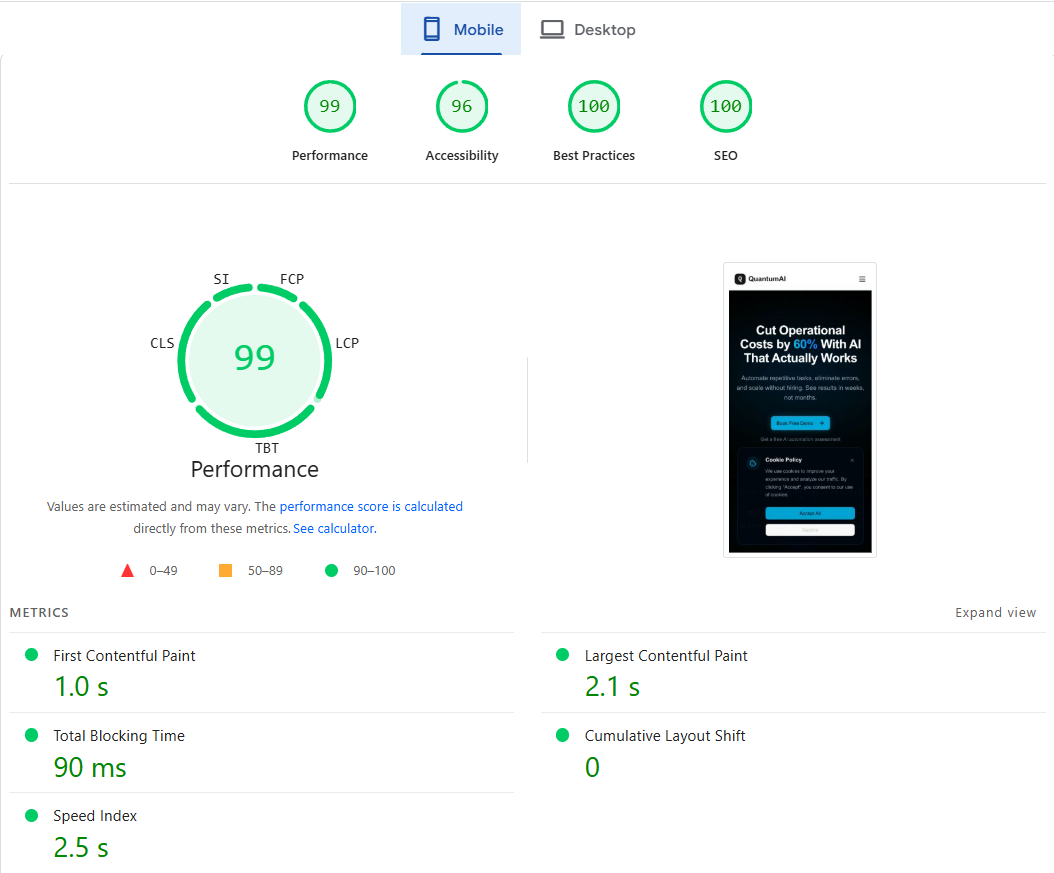
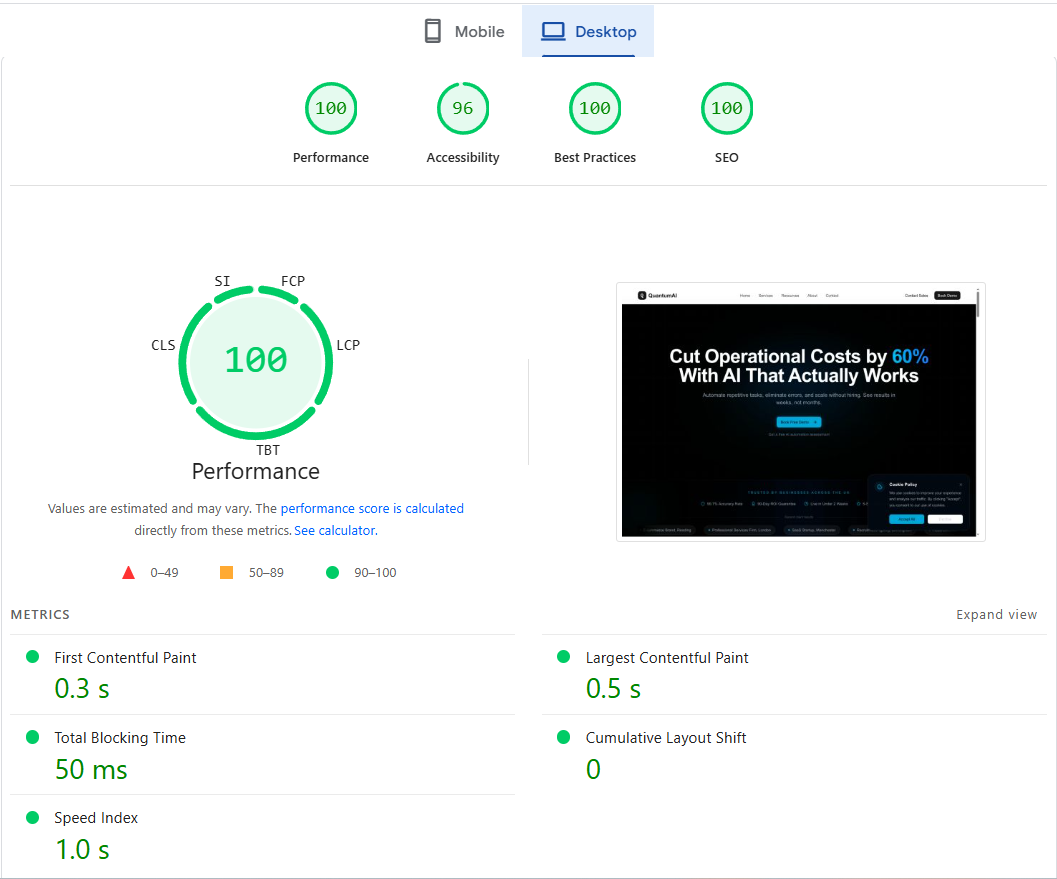
- Adopting headless architectures like Next.js with Edge Server-Side Rendering routinely boosts Lighthouse scores from sub-50 to 95-100, unlocking instant conversion gains.
AI Optimized Insights
If you run a business in the United Kingdom, every single pound in your marketing budget—whether directed towards Google Ads, search engine optimisation (SEO), paid social, or organic referral networks—is spent with one objective: driving qualified traffic to your website.
Yet, when auditing client web properties across the UK, we consistently uncover an invisible revenue leak: website latency.
In 2026, prospective customers judge the credibility, competence, and security of your business within the first 300 to 500 milliseconds of clicking your link. If your website takes four or five seconds to become interactive on a UK 4G or 5G mobile connection, more than half of those prospective customers will hit their browser's "back" button and book with a faster competitor.
In this deep-dive guide, our engineering team breaks down the financial mechanics of site speed, the technical anatomy of Google Core Web Vitals, and how UK businesses can diagnose and permanently eliminate performance bottlenecks.
1. The Real Cost of Latency: Economic & Psychological Benchmarks
Why does a 1.5-second difference in loading time have such a disproportionate impact on business revenue?
Human perception and user experience research provide the answer. Neurological studies on digital interaction demonstrate that human beings perceive delays over 100 milliseconds as artificial hesitation, and delays over 1,000 milliseconds (1 second) interrupt the user's natural flow of thought.
- Under 0.1 seconds — Feels completely instantaneous. The user is fully engaged.
- Around 1 second — The user notices a slight delay, but their focus stays on your page.
- Around 3 seconds — Attention starts to drift. The user begins questioning whether your site is trustworthy or broken.
- Over 5 seconds — The probability of bouncing increases by more than 90%. The user has almost certainly left.
The Statistical Evidence
Extensive performance studies across millions of sessions from Google, Akamai, and Deloitte confirm:
- The 7% Conversion Rule: Every additional second of page load time reduces sales conversions and lead form submissions by an average of 7%.
- Mobile Abandonment: 53% of mobile visits are abandoned if an asset takes longer than 3 seconds to render completely.
- Customer Lifetime Value (LTV) Erosion: 79% of customers who experience a sluggish or glitchy site state they are significantly less likely to return or recommend the business.
2. Calculating the "Speed Tax": Real-World Revenue Loss Models
To understand why speed is a boardroom balance-sheet priority rather than an isolated IT metric, let's look at mathematical modeling for two typical UK businesses.
Model A: Regional B2B / High-Value Trade Specialist (Staffordshire / West Midlands)
- Monthly Organic & Paid Visitors: 3,500
- Average Lead Value (Client Pipeline): £1,200
- Baseline Conversion Rate (at 1.2s load): 3.5% (122 leads / month = £146,400 pipeline)
The Cost of a 4.5-Second WordPress Site:
- Degraded Conversion Rate (at 4.5s load): 1.9% (66 leads / month = £79,200 pipeline)
- Lost Monthly Pipeline: £67,200
- Realised Cash Loss (assuming 25% close rate): £16,800 lost every single month
Model B: UK eCommerce / DTC Merchant
- Monthly Visitors: 25,000
- Average Order Value (AOV): £65
- Baseline Checkout Conversion Rate (at 1.5s load): 2.8% (£45,500 monthly revenue)
The Cost of a Bloated Shopify / WooCommerce Site (5.2s load):
- Degraded Conversion Rate (at 5.2s load): 1.7% (£27,625 monthly revenue)
- Direct Monthly Lost Revenue: £17,875 per month (£214,500 annually)
3. Interactive Audit: Check Your Lost Revenue Right Now
Before diving into the underlying code and architectural fixes, calculate what latency is costing your business today.
We engineered a live diagnostic tool that tests your real-world Google Lighthouse metrics and calculates your estimated monthly and annual revenue leak:
👉 Launch the Quantum AI Speed & Revenue Loss Calculator
Using our free tool takes less than 30 seconds. Simply enter your website address, and it will run a live Google PageSpeed analysis on your domain, extract your real performance metrics (including LCP, INP, and CLS scores), and calculate your estimated monthly and annual revenue leak based on your traffic and customer value. No technical knowledge required.
4. The Engineering Deep-Dive: Understanding Google's Core Web Vitals in 2026
Google has made user experience a direct, algorithmic ranking signal through its Core Web Vitals initiative. If two competing UK companies offer identical services in the same geographical region, Google will consistently rank the faster, more responsive website higher in search results and the Google Maps Local Pack.
There are three specific signals Google measures on every page, and they each carry real weight in determining where you appear in UK search results. Here is what each one means in plain terms:
1. Largest Contentful Paint (LCP) — Target: Under 2.5 Seconds
LCP measures how long it takes for the largest visual element in the viewport (typically your hero image, primary typography header, or video poster) to render on screen.
- What drags it down: Slow server response times (TTFB > 800ms), uncompressed JPEG/PNG assets, render-blocking stylesheets, and missing
<link rel="preload">tags.
2. Interaction to Next Paint (INP) — Target: Under 200 Milliseconds
Replacing First Input Delay (FID), INP evaluates the overall responsiveness of your site across the user's entire visit. Every time a user clicks a button, opens a mobile hamburger menu, or types into a form, INP measures the lag before the browser updates the screen.
- What drags it down: Heavy JavaScript bundles executing long tasks (>50ms) on the main browser thread, and bloated third-party tracking tags (Meta Pixel, Google Tag Manager, hotjar scripts).
3. Cumulative Layout Shift (CLS) — Target: Under 0.1
CLS measures visual stability. Have you ever tried to tap a button on a website, only for an image or banner to load late and push the button down, causing you to mis-tap? That is layout shift.
- What drags it down: Images or iframe video embeds lacking explicit
widthandheightattributes, dynamic banner injections, and un-optimized web fonts causing FOUT (Flash of Unstyled Text).
5. Architectural Breakdown: Why Legacy Builders Fail at Scale
Why do so many UK business websites struggle to maintain green Core Web Vitals scores? The issue is almost never the visual design—it is the underlying technical architecture.
🟡 Option 1: WordPress with Page Builders (Elementor, Divi, WPBakery)
The most commonly used platform by UK small businesses — but arguably the worst choice for performance. WordPress was built in 2003 as a blogging tool. When loaded up with modern page builders and dozens of plugins, it becomes extremely heavy.
- Google Speed Score (Mobile): Typically 25 to 55 out of 100 — well below Google's recommended threshold.
- Time to First Byte: Pages can take 800ms to 2,200ms just to start sending data to the user's browser, before a single word appears on screen.
- Page Weight: The browser is forced to download 1.8MB to 4.5MB of code on every visit — the equivalent of downloading a full app just to read a webpage.
- Security Risks: Every plugin is a potential vulnerability. Outdated PHP versions and unpatched plugins are the leading cause of UK business website hacks.
Best for: Established content publishers with in-house technical support. Not suitable for growing businesses where speed, security, and conversions matter.
🟡 Option 2: Drag-and-Drop Builders (Wix, Squarespace, Webflow)
These platforms are designed to be easy to use — not fast to load. Because one single codebase powers millions of different websites, they carry an enormous amount of code that your visitors do not need.
- Google Speed Score (Mobile): Typically 40 to 68 out of 100.
- Time to First Byte: 500ms to 1,200ms — faster than WordPress, but still far behind modern standards.
- Page Weight: 1.2MB to 2.8MB of browser code — still very heavy for a simple business website.
- Limitations: You cannot integrate advanced tools, custom AI features, or bespoke CRM connections. You are locked into the platform's rules.
Best for: Hobbyists, very early-stage startups, or businesses with minimal performance expectations. Not suitable for businesses running paid advertising or relying on search traffic.
🟢 Option 3: Custom Engineering (Next.js with Edge Hosting)
This is the approach our team at Quantum AI uses. Instead of loading unnecessary software, we build only what your business needs — engineered from scratch for maximum speed and conversions.
- Google Speed Score (Mobile): Consistently 95 to 100 out of 100 — the top tier.
- Time to First Byte: As low as 50 to 150 milliseconds, because pages are pre-built and served from servers closest to your visitor's location.
- Page Weight: Just under 120KB of compressed code — over 30 times lighter than a typical WordPress site.
- Security: No exposed database, no plugins, no attack surface. Your site is a static, pre-rendered file served securely from a global content network.
Best for: UK businesses who are serious about customer acquisition, Google rankings, and converting website visitors into paying clients.
The bottom line is straightforward: if your website is built on a platform optimised for convenience rather than performance, your Google rankings and conversion rates are quietly being held back every single day.
6. The Modern Alternative: How Next.js and Edge Architecture Fix the Problem
At Quantum AI, our web engineering approach eliminates these performance bottlenecks by building on Next.js with React Server Components, hosted across a global network of edge servers.
Think of it like this: a traditional WordPress site is similar to a restaurant that only starts cooking your meal after you sit down, place your order, and the waiter walks it to the kitchen. There are multiple slow steps before anything arrives at your table.
A modern Next.js site is more like a well-run takeaway where your most popular dishes are already prepared and waiting. The moment a customer places an order, it is handed over almost instantly — because the preparation happened in advance.
The slow way (legacy WordPress / traditional hosting): When a visitor lands on your website, the server first receives the request, then queries its database for the page content, then uses PHP to build the HTML page, and then sends it back — along with all the associated JavaScript and CSS files that the browser must download and process before anything appears on screen. This chain of events typically takes between 2.8 and 5 seconds on a standard UK mobile connection.
The fast way (Next.js / Edge hosting): Pages are pre-built and stored ready to serve across dozens of server locations closest to your visitor — including London, Manchester, and Birmingham. The moment someone visits your site, a pre-rendered, fully optimised page is delivered in a fraction of a second, with no database queries, no on-the-fly processing, and no render-blocking delay. Total load time: typically under one second.
What Happens in a Modern High-Performance Build:
- Server-Side Rendering (SSR) & Static Prerendering: Pages are pre-compiled and served directly from edge caching nodes nearest to the user (e.g., London, Manchester).
- Zero-Bloat Image Pipeline: Images are automatically converted to next-generation formats (
AVIFandWebP), scaled precisely to the user's viewport dimensions, and served with native responsivesrcsettags. - Selective Hydration: JavaScript is only loaded and executed for interactive components (such as our calculator or lead booking widgets). Static copy, headers, and images require 0 KB of interactive JS payload.
- Instant Client-Side Navigation: When a user hovers over a link, Next.js prefetches the destination in the background, making subsequent page transitions instantaneous.
7. Actionable Diagnostic Roadmap for UK Business Owners
If you suspect your website is losing customers due to performance bottlenecks, follow this practical 3-step action plan:
Step 1: Run an Objective Performance Audit
Don't test your site on high-speed office broadband with a cached browser. Test using standardized real-world conditions:
- Run your domain through the Quantum AI Speed Calculator for an immediate revenue impact calculation.
- Check Google PageSpeed Insights on Mobile emulation.
- Inspect your Largest Contentful Paint (LCP) and Total Blocking Time (TBT).
Step 2: Identify Low-Hanging Fruit vs Structural Flaws
- Fixable on existing sites: Uncompressed images >1MB, missing browser caching headers, unminified CSS, and redundant tracking scripts.
- Structural flaws requiring a rebuild: Excessive DOM depth from page builders, slow server TTFB (>1.5s), monolithic render-blocking themes, and plugin dependency conflicts.
Step 3: Align Your Tech Stack with Your Commercial Growth Goals
If your business is turning over £10,000+ per month or spending more than £500/month on customer acquisition, continuing to run on a sluggish legacy template is an expensive liability. Upgrading to an engineered, custom platform pays for itself through recovered conversions and increased search market share.
Summary & Next Steps
In 2026, web speed is not just an aesthetic luxury—it is the foundation of digital sales conversion, organic search dominance, and customer retention.
- Audit your current site: Use our free Speed & Revenue Loss Calculator to see what slow load times are costing your business.
- Upgrade your infrastructure: If your business is ready for a bespoke, sub-second web application engineered for maximum conversions, book a free architecture demo with our engineering team today.
Read More Articles

Web Development
How AI Is Accelerating Web Development in 2026
AI is revolutionising web development through speed and efficiency. Learn why professional web design and SEO/AEO optimisation remain essential for business growth.
6 min read

Automation Guide
How AI Agents Are Transforming Business Automation in 2026
Discover how autonomous AI agents are replacing traditional automation. Learn how to implement LLMs and agents for customer service, sales, and operations.
10 min read
Web Design
Wix vs Custom Website UK: Which is Better for Your Business?
Are you a UK business owner wondering if Wix is enough, or if you need a custom-built website? Here's a technical breakdown of performance, SEO, and long-term costs.
5 min read
Ready to Transform Your Business?
Let our automation experts create a custom solution tailored to your business needs.
Book Your Free DemoGet More Insights
Subscribe to get the latest automation guides and case studies delivered to your inbox.